
There is a Disc column on nearly every bill a distributor sends you. Ten per cent, fifteen, sometimes a flat figure at the foot marked cash discount. It is agreed on the phone in about four seconds and entered in about two.
And then, in most pharmacies, it is thrown away — not deliberately, but by the way the bill gets typed in. What goes in is the net rate. The discount itself is gone by the time anyone could use it.
Start with one line
Ten strips at ₹100, ten per cent trade discount, two free with the scheme. A bill you have had a hundred times.
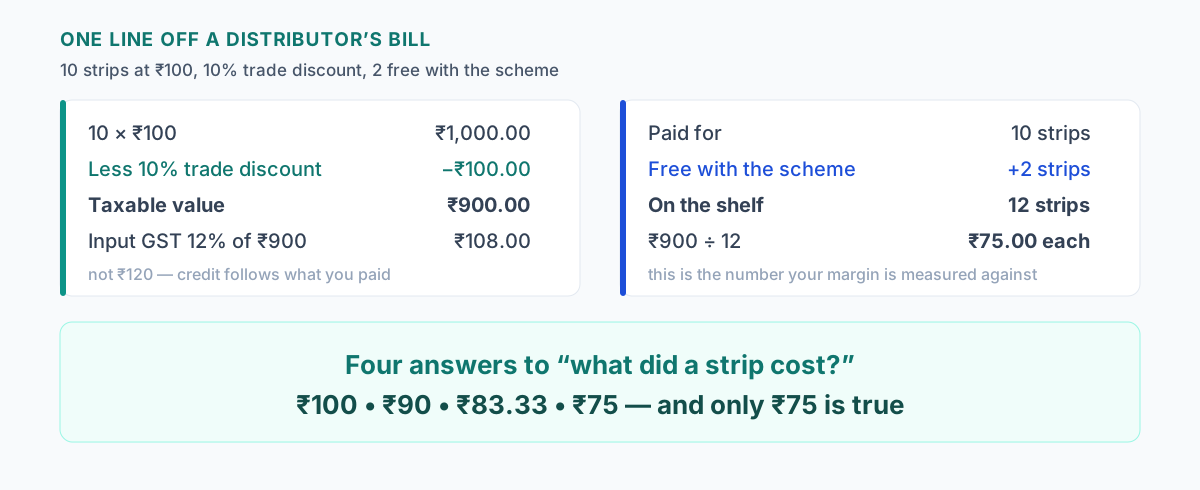
Four numbers are defensible and only one is useful. ₹100 is the list price. ₹90 is the rate after the discount. ₹83.33 is what you get if you spread the list price over the free goods and forget the discount. ₹75 is what a strip on your shelf actually cost you, and it is the only one of the four that can tell you whether selling it at ₹95 made you any money.
Typing the net rate throws away the deal
Most pharmacy software has no column for a discount, so the shop does the sensible thing: it types ₹90 into the rate and moves on. The bill totals correctly. Nothing looks wrong.
What has gone is the pair of facts worth keeping — the list price was ₹100 and you got ten per cent. Three months later you cannot answer any of these:
- Was this month's deal better than last month's? Two bills both say ₹90. One was ten per cent off ₹100; the other was twenty per cent off ₹112.50. You negotiated harder and did no better.
- Did the list price move? A distributor who raises the list and keeps the headline discount the same is giving you less for the same words. If you only ever store the net rate, the change is invisible.
- Does your copy match theirs? When a query comes back on an invoice six weeks later, their bill has a rate and a discount. Yours has one number that matches neither.
This is not a reporting nicety. The discount percentage is the thing you actually negotiate, and it is the one number you are not keeping.
The tax comes off with it
Input tax credit follows what you paid, not what the price list said. Ten per cent off ₹1,000 leaves ₹900 taxable, so the credit on a 12% line is ₹108 — not ₹120.
Claim the ₹120 and two things happen. You have claimed ₹12 of credit on money nobody paid. And your claim no longer agrees with what the supplier declared, which is exactly the sort of difference that surfaces when GSTR-2B is reconciled — months later, on a line you will have no memory of.
A shop that types the net rate is usually safe here by accident: taxing ₹90 × 10 gives the right answer. A shop that types the list price and takes the discount off the total is not.
A cash discount at the foot is not pocket money
The other kind of discount — a lump at the bottom of the bill, often for paying inside seven days — gets treated as a separate little win. It is not. It is a reduction in the cost of the goods on that bill, and until it is spread back across the lines, every per-item cost you hold is too high.
It matters most on a mixed bill. If ₹150 comes off a bill carrying both 12% and 5% items, how much of it came off which? Software that cannot answer that cannot build you a correct purchase register, because GST is accounted for per rate.
Scheme goods and a discount compound
Most shops that do cost their free goods stop there — ₹1,000 over twelve strips, ₹83.33 each — and leave the trade discount out of it. The two multiply. Ten per cent off and two free is ₹75 a strip, a quarter off the list price, and a margin at ₹95 of ₹20 rather than the ₹5 the list price suggests.
Run that over a year on the twenty lines you buy every week and it is the difference between a shop that knows which distributor is worth the call and one that is guessing.
Three things to check this week
- Take the last bill you entered and find the discount on it. If the number is not anywhere in your software, you are storing a rate that cannot be traced to anything the distributor sent you.
- Pick one fast-moving medicine and work out what a unit really cost on your last purchase — list price, less discount, over paid plus free. Compare it with what your software says the stock cost. If they differ, every margin figure on that medicine is wrong by the gap.
- Take one bill with a trade discount and check the input tax you claimed on it. If the tax is the full rate on the undiscounted value, you have claimed credit you did not pay for.
None of this is an argument against discounts — a discount you negotiated is the cheapest margin a pharmacy ever gets, far cheaper than selling more. It is an argument for writing it down.
We wrote about the other side of this, the discount you give, in what a discount really costs; and about free goods, distributor rates and credit days in where a pharmacy really loses its margin.
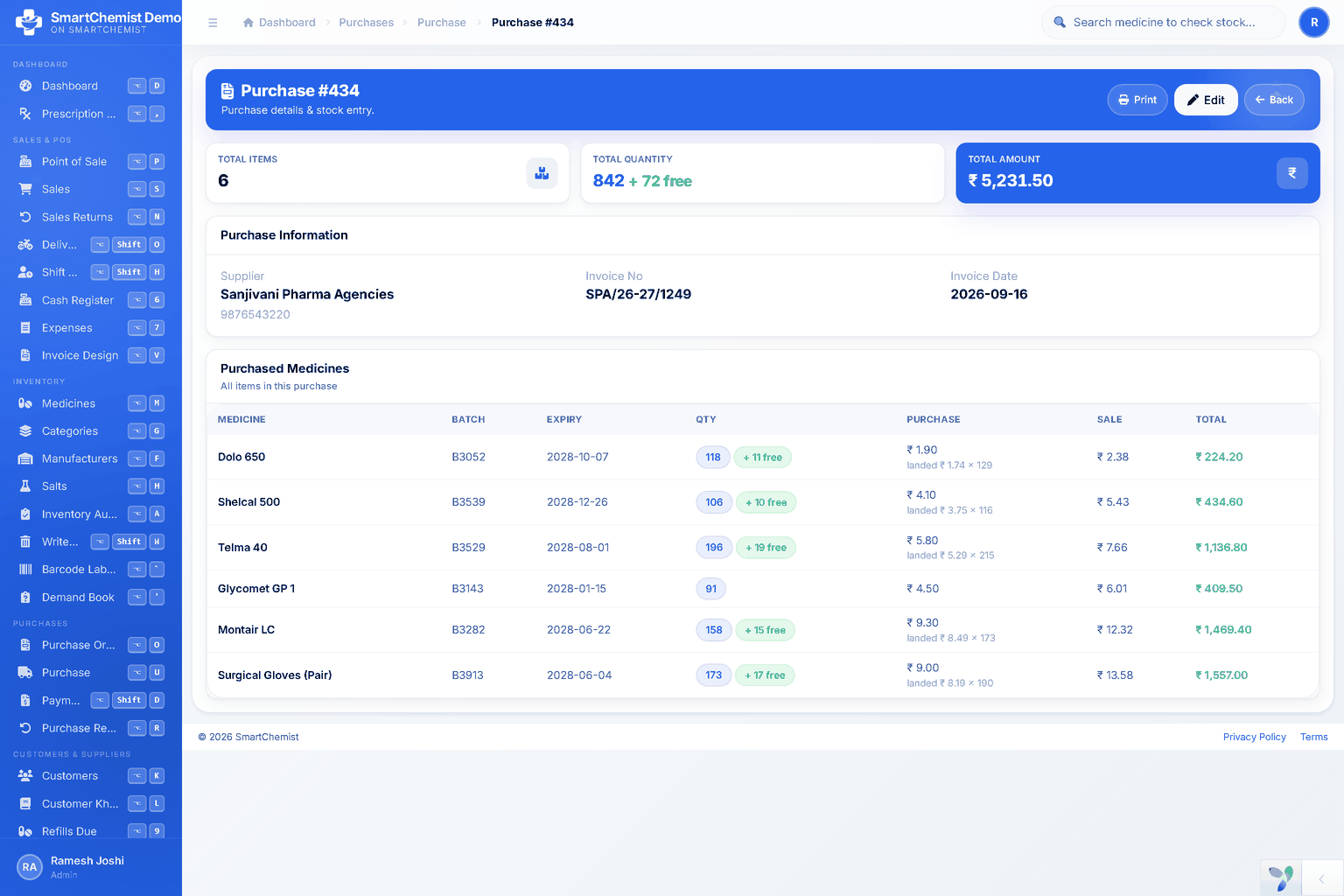
In SmartChemist a purchase line has its own discount box — rupees or a percentage, kept as you typed it — and a cash discount at the foot of the bill is spread across the lines in proportion. The taxable value and the input tax follow it, and so does the cost recorded against the batch, so the profit on that stock is measured against what you actually paid for it rather than what the price list said.