
Ask a pharmacy owner what their biggest asset is and they will say stock. Ask what keeps them awake and it is usually something else: the money sitting with customers who took medicines on credit and have not come back to settle.
Credit is not a mistake. In most Indian medical stores it is unavoidable — the regular family, the chronic patient collecting a monthly course, the clinic next door that sends a boy with a list. Refuse credit outright and much of that business walks to the shop across the road. The problem is almost never that a pharmacy gives credit. It is that nobody knows how much, to whom, or for how long.
The Diary Problem
Most stores start with a notebook under the counter. It works when there are five names in it. By the time there are forty, spread over three pages and two handwritings, it has quietly stopped being a record and become a pile of reminders.
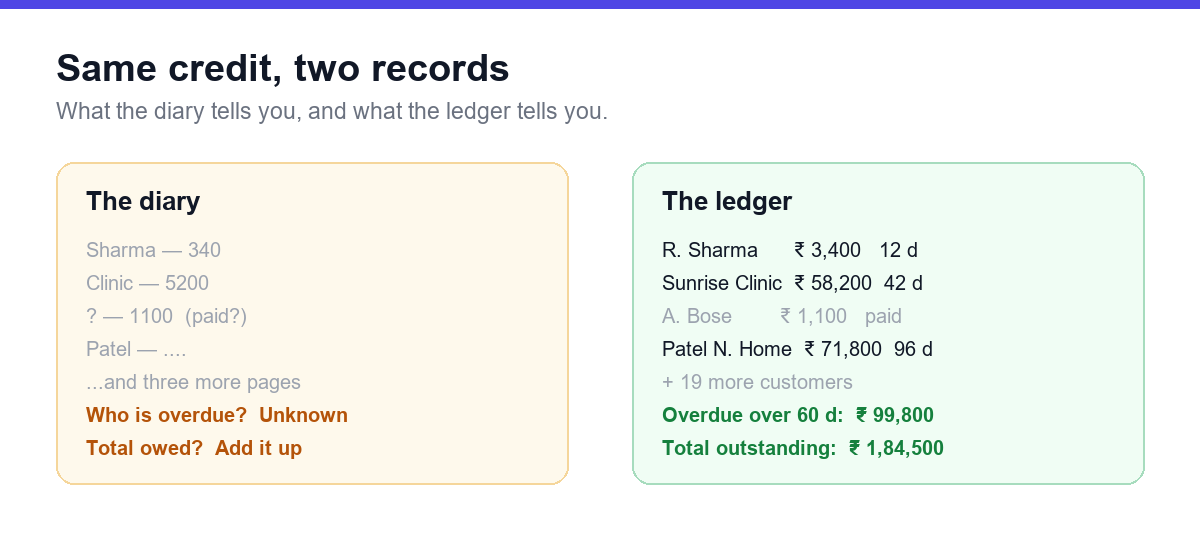
The difference is not neatness. It is that one of these can answer a question and the other cannot. Who is overdue? How much is at risk? Should this customer get more credit today? A diary makes you add it up before you can even begin, which in practice means nobody adds it up at all.
Not All Outstanding Is Equal
Here is the shift that changes how credit gets managed: stop looking at the total and start looking at the age.
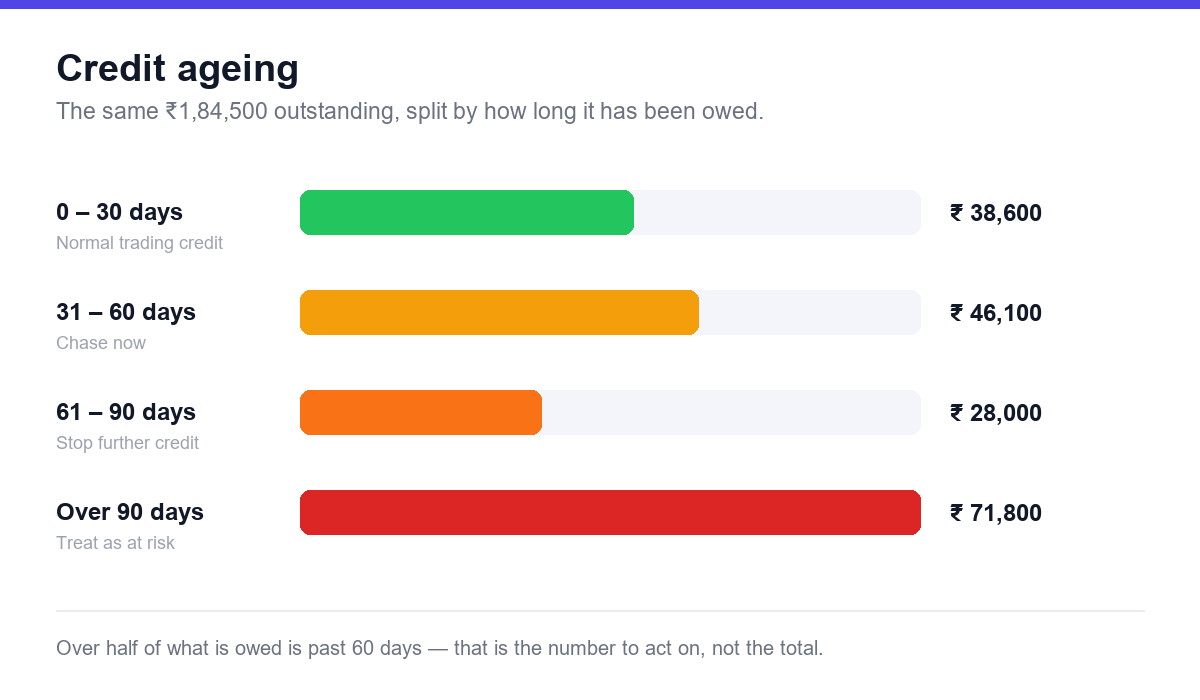
Money owed for twelve days is normal trading. Money owed for a hundred days is a different thing entirely — it is not really credit any more, it is a debt you have not admitted to yourself. Two stores can both be owed the same amount and be in completely different positions depending on how that money is spread.
The rough working rule most owners settle on:
- 0–30 days — normal. Leave it alone.
- 31–60 days — call now, while the customer still remembers the purchase.
- 61–90 days — no further credit until this clears.
- Over 90 days — treat it as at risk and decide whether you are collecting it or writing it off. Leaving it undecided is the worst of the three options.
Four Habits That Keep Credit Under Control
1. Record it at the counter, never later
The entry has to happen while the customer is standing there, attached to the bill. Written up at closing time, credit sales get missed, amounts get rounded from memory, and a payment that came in at four o'clock never gets recorded against anything. The gap this creates is the single biggest source of arguments with regular customers, and the pharmacy usually loses those arguments because the customer is more certain than the record.
2. Give every credit customer a limit
Not a vague sense of how much is reasonable — an actual number. It can be small for a new customer and generous for a clinic that has paid on time for three years. The point is that when someone reaches it, the decision to extend further is a conscious one made by the owner, rather than something that happens by default because nobody was counting.
3. Age the list once a month, not once a year
Twenty minutes on the first of the month, going down the list oldest first. Most of what looks alarming in a total turns out to be two or three names. Those are the calls to make. Chasing everybody equally is how the exercise becomes a chore and then stops happening.
4. Chase at thirty days, not ninety
A polite call at thirty days is a reminder. The same call at ninety days is a confrontation, and the customer has usually spent the money by then. The collection rate on recent debt is far better than on old debt, and the relationship survives the conversation. That difference is almost entirely about timing rather than about how firmly you ask.
Clinics and Nursing Homes Need Separate Treatment
Institutional credit behaves differently from a family's monthly account. The amounts are bigger, the payment cycle is genuinely longer, and there is usually a person in an office rather than the person who collected the medicines.
Three things make these accounts safer:
- Agree the payment cycle in writing at the start — fortnightly, monthly, whatever — rather than discovering it by observation.
- Send a consolidated statement on a fixed date instead of chasing individual bills. It is easier for them to pass for payment and easier for you to follow up on.
- Know the name of the person who releases payment. Chasing the doctor who ordered the medicines rarely moves anything.
Where Software Actually Helps
None of the four habits above need software. They need a record that can be sorted and totalled, which a well-kept register can be. What software removes is the part people give up on: doing it every single time, and having the answer ready before you are asked.
In SmartChemist, a credit sale goes onto the customer's ledger as part of billing rather than as a second job afterwards, so the balance is correct without anyone maintaining it. The customer list can be sorted by outstanding amount and by how long it has been owed, which is the monthly review already done for you. And because the balance is on screen at billing time, the question "should this customer get more credit today?" gets answered before the medicines leave the counter rather than after.
Start Here
If credit has quietly grown into a number nobody has looked at, one afternoon fixes most of it:
- Write down every name that owes you money and the amount, from whatever records you have.
- Put a date against each — roughly when it was taken. Approximate is fine.
- Sort by that date, oldest first.
- Call the top five.
Most owners find the total is smaller than they feared and more concentrated than they expected. Both of those are good news: a problem held by four or five customers is a problem you can actually do something about this week.