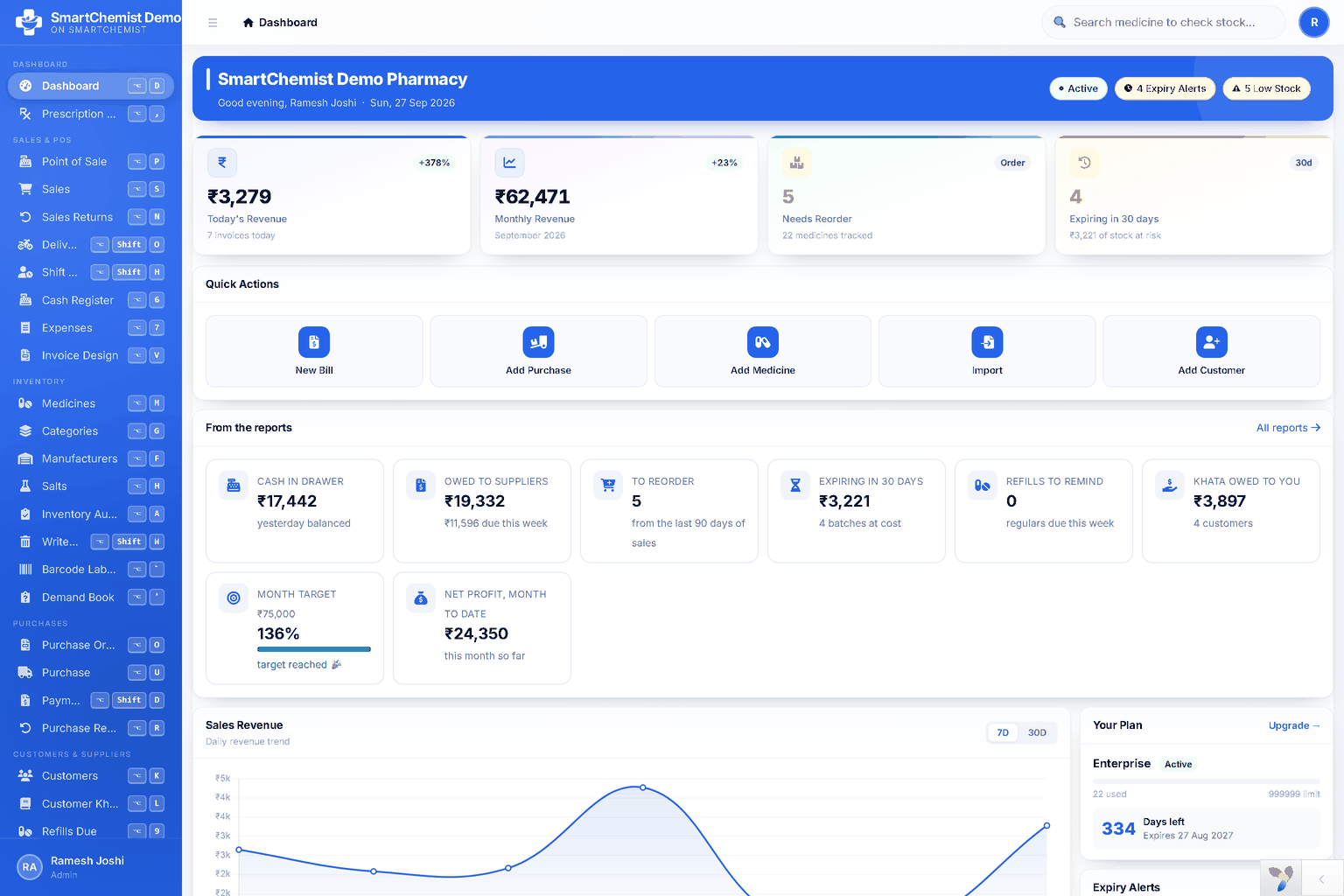
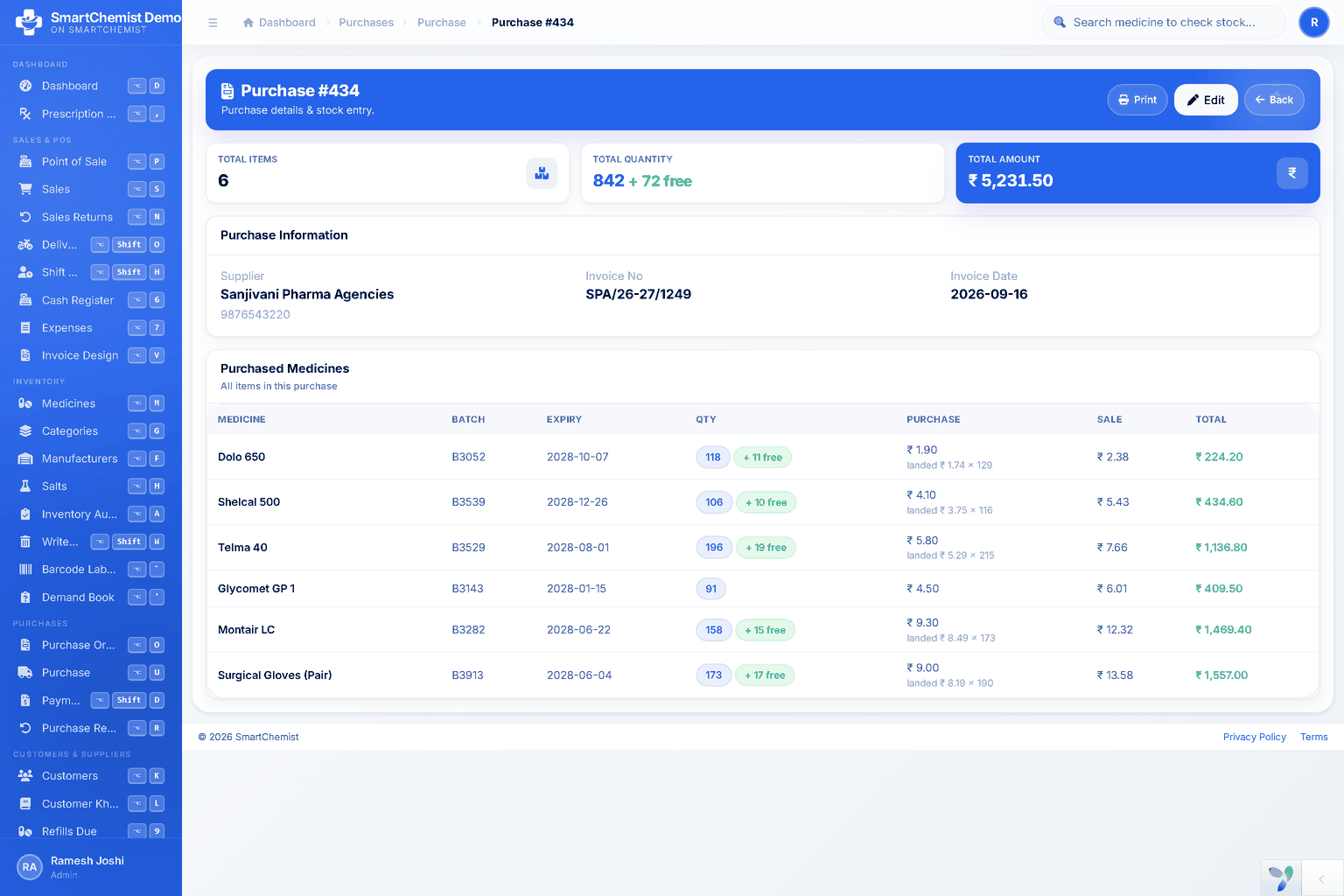
Ask a pharmacy owner where the profit went and the answer is usually about selling - discounts given, credit not collected, expiry written off. Those are real. But a good deal of the margin in a medical store is decided before a single strip is sold, in the twenty minutes a week somebody spends entering the distributor's bill.
Three things go wrong there, quietly, in almost every shop.
1. Free goods are not free, and pricing them at zero hides a real margin
A distributor offers ten free with a hundred. It feels like a discount and it is, but the way it usually gets recorded turns a good deal into a bad number: the hundred go in at the bill rate and the ten go in at nothing.
Now the shop has 110 strips with two different costs on them, and the profit report is wrong in both directions - too pessimistic on the paid ones, absurdly optimistic on the free ones. Sell a free strip and the software reports the whole selling price as profit. Nobody believes it, so nobody trusts the profit report, so nobody uses it.
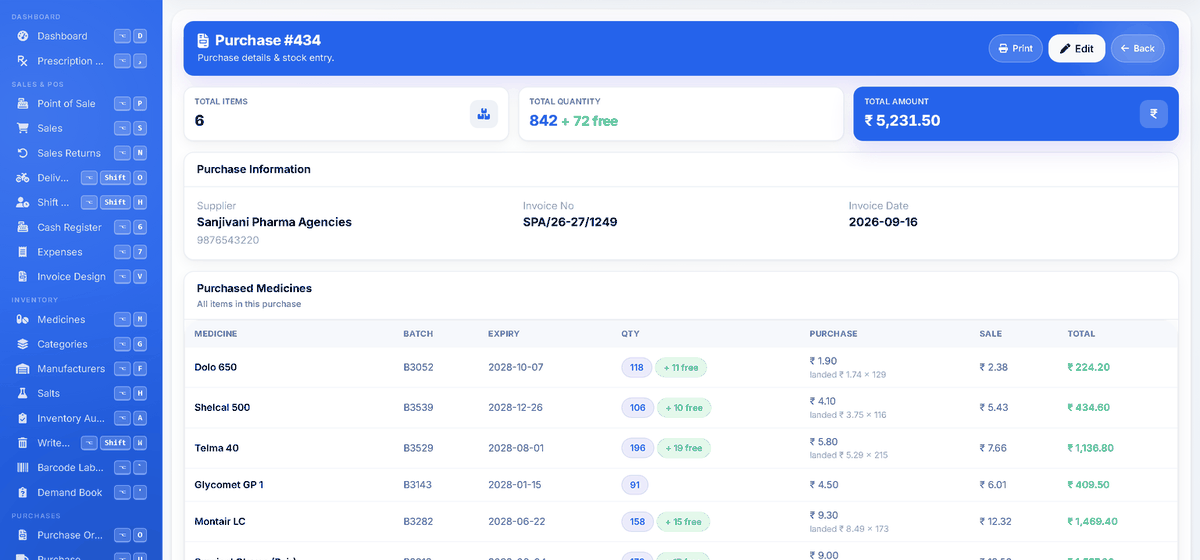
What should happen is the arithmetic a good buyer does in their head anyway. The bill is for a hundred; a hundred and ten arrived; the cost per strip is the bill value divided by a hundred and ten. On the screen above that is the small line under each rate: the bill charged ₹9.30 for 158 units of Montair LC and 15 came free, so the cost carried into stock is ₹8.49 across all 173. Every strip in the batch carries the same honest cost, the scheme shows as what it was, and the profit on the shelf is a number you can plan against.
It matters most on exactly the lines where schemes are offered: the fast-moving, low-margin ones you buy by the hundred.
2. The same medicine, three rates, and nobody adds it up
Most shops buy from two or three distributors, for perfectly good reasons - one is nearer, one delivers on Sunday, one carries the brand the doctor next door prescribes. Over a quarter that means the same medicine arrives at several different rates, each one reasonable on the day, none of them ever compared.
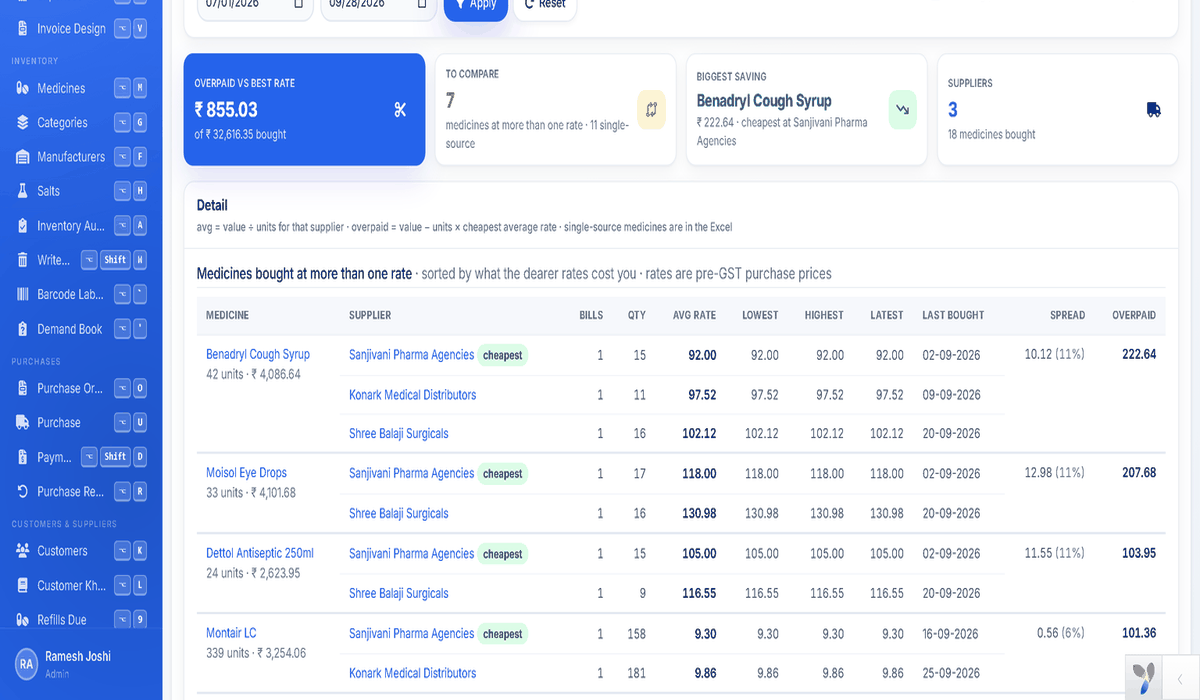
This is the same three months of buying a shop has always done, sorted by what the dearer rates cost. An 11% spread on a cough syrup is not a scandal - it is one distributor's normal rate against another's - but ₹855 on ₹32,616 of buying is a third of a day's takings, and it was invisible until the same purchase entries were read a different way.
Worth saying plainly: the cheapest rate is not always the right one. Sunday delivery, a distributor who takes expiry back without an argument, or credit terms you actually need are worth paying for. The point is to know what they cost, and to have the number in front of you the next time rates are discussed.
3. Credit days that exist in someone's memory
Every distributor gives terms - 21 days, 30 days, sometimes 45 on a big order. Almost no shop writes them down. The result is a pharmacy that either pays too early, giving up working capital it has already earned, or pays too late and loses the terms on the next order.
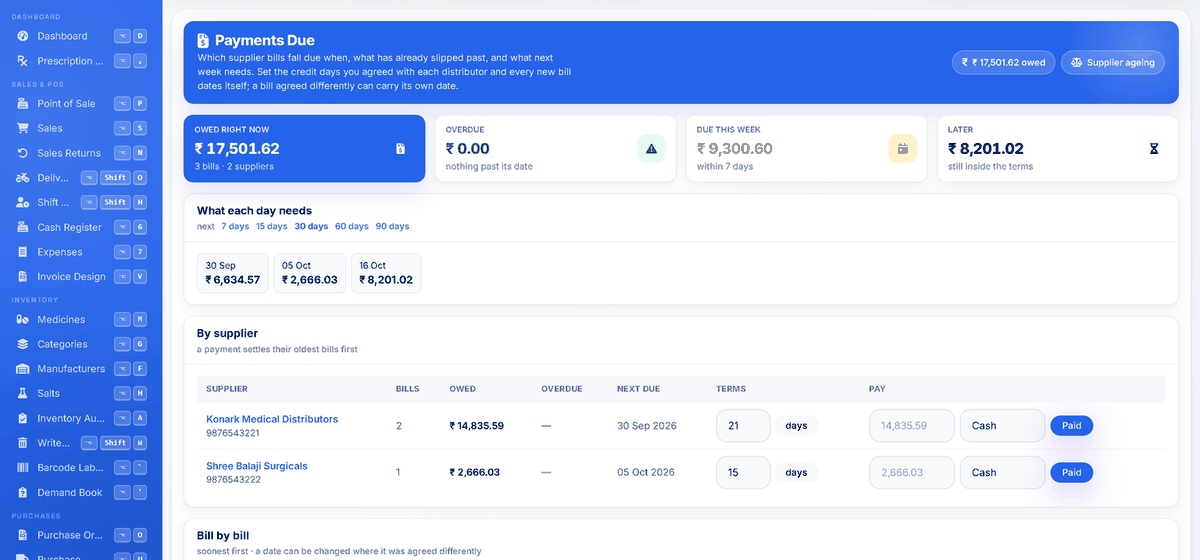
Agree the days once per distributor and every new bill dates itself. Then the question stops being "how much do we owe" - a number no one can act on - and becomes what does 30 September need. Here it is ₹6,635 on 30 September, ₹2,666 on 5 October, ₹8,201 on the 16th. That is a cash plan, and it fits on a phone.
The same page keeps the bill dates honest where a bill was agreed differently from the usual terms, which is the case a memory-based system always gets wrong.
What the khata is for
All of it lands in the same place: an account per distributor that adds itself up.
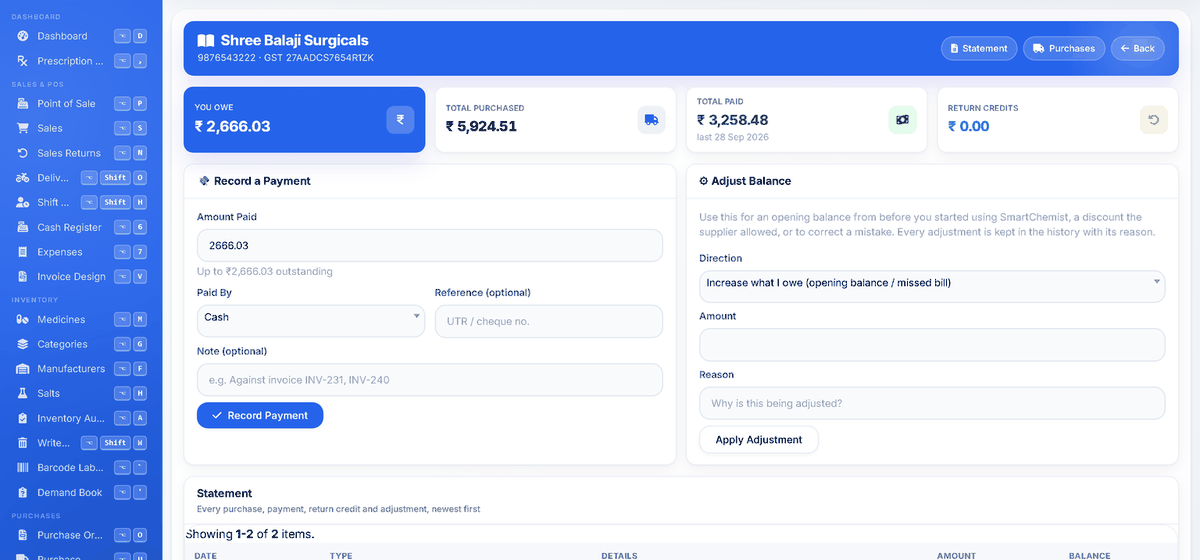
What you owe, what you have paid and when, and what they owe you back for expiry returns - in one running balance, in date order. This distributor was paid ₹3,258 of ₹5,925 on the 28th, so ₹2,666 stands against the next visit. When a distributor's man arrives with his own book and the two do not agree, the conversation takes two minutes instead of an evening, and it is usually a return credit that never reached their side.
Four things to check this week
- Pick one scheme line you bought recently and work out the true cost per strip - bill value divided by everything that arrived. Compare it with the cost your records show.
- Pick three fast movers and list what each distributor last charged for them. If you cannot answer without ringing someone, that is the finding.
- Write down the credit days you have with each distributor. Not from memory - from the last bill each one sent.
- Ask for the return credits sitting on each account. Expiry that went back and was never credited is the most commonly forgotten money in a pharmacy.
None of that needs software. It needs the information to be somewhere other than a diary and a good memory - which is the whole job, and the reason the buying side is where a quiet, repeatable margin usually hides.
If you would rather it happened while you entered the bill you were entering anyway, that is what SmartChemist's purchase side does: scheme goods costed at what they really cost, rates compared across distributors, credit days on every bill, and a khata per supplier. Read the full feature list, or try it on your own buying - the free trial is the whole product.