A regular asks for something off. A bill comes to ₹1,247 and you make it ₹1,200. Somebody mentions a price they saw online. Every pharmacy in India discounts, several times a day, and the decision is made in about two seconds at a counter with three people waiting.
That is fine. What is not fine is that almost nobody knows what one costs — and the arithmetic has a trap in it that quietly overcharges the customer and overstates the tax you owe.
Start with one strip
A strip you bought at ₹36 and sell at ₹50, GST 12%. Somebody asks for ten rupees off.
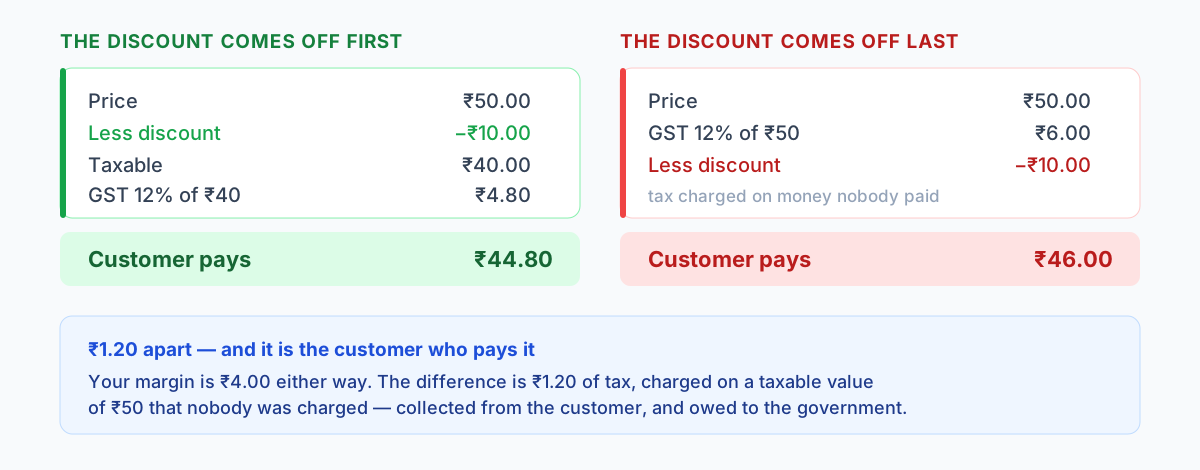
Both columns feel like "ten rupees off". They are not the same bill.
The tax comes off with the discount
GST is charged on what the customer actually pays. A discount given at the time of sale and shown on the invoice comes off the taxable value, and the tax is worked out on what is left. ₹50 less ₹10 is ₹40; the tax is 12% of ₹40, which is ₹4.80, and the bill is ₹44.80.
Do it the other way — tax the full ₹50, then take ten rupees off the total — and the customer pays ₹46.00. They have been charged ₹1.20 of tax on money nobody paid, and you owe that ₹1.20 to the government. Your margin is ₹4.00 either way; the extra came out of the customer's pocket and went straight through you to the tax authority.
It is a small sum on one strip. It is not a small sum across a year of discounts, and it is the sort of discrepancy that is very hard to explain when somebody adds up an invoice in front of you: the bill says taxable ₹50 when the customer plainly paid ₹40 for the goods.
What it costs you, stated plainly
Ten rupees off that strip costs you exactly ten rupees of margin. Not eight, not "a bit" — ten, because the discount comes out of the gap between what you paid and what you charge, and nothing else moves.
- At full price: ₹50 less ₹36 of stock is ₹14 of margin, 28%.
- With ₹10 off: ₹40 less ₹36 is ₹4 of margin, 10%.
A fifth off the price took nearly three quarters of the profit. That is the number worth carrying in your head at the counter, and it is why "twenty per cent off" is a very different sentence in a pharmacy than it is in a clothes shop.
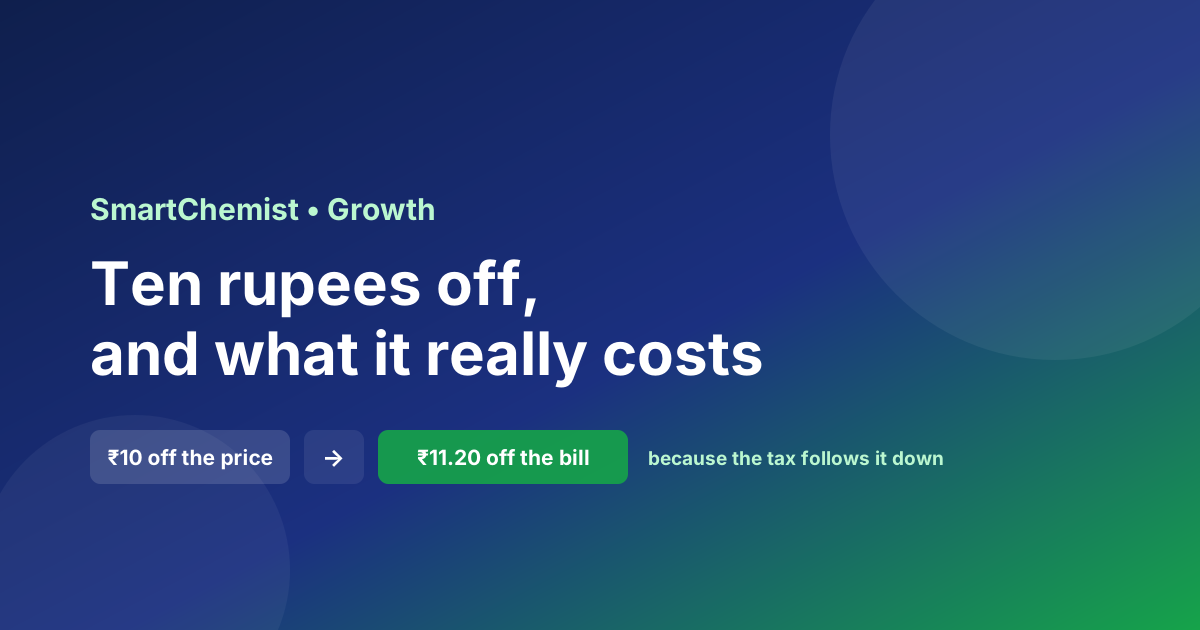
And the customer saved ₹11.20, not ₹10 — the tax came down with the price. Worth saying out loud when you give it; a discount you do not get credit for is the worst kind.
Give it on the line, not at the bottom of the bill
Most software only lets you discount the whole bill. That is the wrong shape for the way discounting actually happens: it is usually about one thing — the expensive strip, the item somebody is comparing against a price online, the one line a regular always asks about. The rest of the basket is not up for negotiation.
A discount given on the line tells you, later, which medicines you keep giving away. A discount thrown at the bottom of the bill tells you nothing except that you gave something away on a Tuesday.
It matters for the tax too. A bill-level discount still has to be spread back across the lines before the tax can be worked out, because GST is charged per rate — if your basket has 5% and 12% items in it, a lump at the foot of the bill does not say how much of it came off which. Software that does not do that apportionment is guessing, and your return is built on the guess.
Three places the discount gets lost after the sale
This is where a discount stops being a decision and becomes a mess, and all three are worth checking in whatever you use today.
- The refund. A customer returns the strip you sold at ₹10 off. If your software refunds the price list, you hand back ₹56 for something they paid ₹44.80 for. Nobody notices, because the refund looks "right" against the shelf price.
- The profit report. If revenue is counted at list price, the report says you earned ₹14 on a strip that earned you ₹4. Every discount is invisible, and the medicines you discount most look like your best sellers.
- The GST return. If the register totals quantity times list price, it declares more output tax than you collected — and it will not reconcile against the invoices it is supposed to summarise.
Scheme goods are a discount too
Ten free with a hundred is a discount the distributor gave you, and the same rule applies in reverse: the cost per unit is the bill value divided by everything that arrived, not by what was billed. We wrote about that side of it in where a pharmacy really loses its margin. The habit is the same at both ends of the shop — know what the thing actually cost, and what it actually earned.
Three things to check this week
- Take a bill you discounted and check the GST on it. If the tax equals the full rate on the undiscounted value, every discounted bill you have issued overcharged the customer slightly and overstated your output tax.
- Return a discounted item, on paper. Work out what should go back, then see what your software says. If it refunds the shelf price, you have been giving money away on returns.
- Look at your top ten medicines by value and ask which of them you routinely discount. If the report cannot tell you, it is ranking them by a price nobody paid.
None of this makes discounting wrong. A ten rupee discount that keeps a customer who spends ₹2,000 a month is the cheapest marketing a pharmacy has. It is worth knowing what it costs, which is a different thing from being afraid of it.
In SmartChemist you can take money off a single line — rupees or a percentage — at the till or on the sale form. The tax is charged on what is left, the discount is printed on the invoice where the customer and the rules both want it, a refund gives back what was actually paid, and the reports count what you earned rather than what the price list says.