
A distributor's bill and a pharmacy's shelf count the same medicine in two different ways, and almost nobody notices until the stock is wrong. The bill is written in strips, because that is how the wholesaler sells. The counter works in capsules, because that is how a customer asks. Both are correct. Entering one as if it were the other is where a week of stock goes missing.
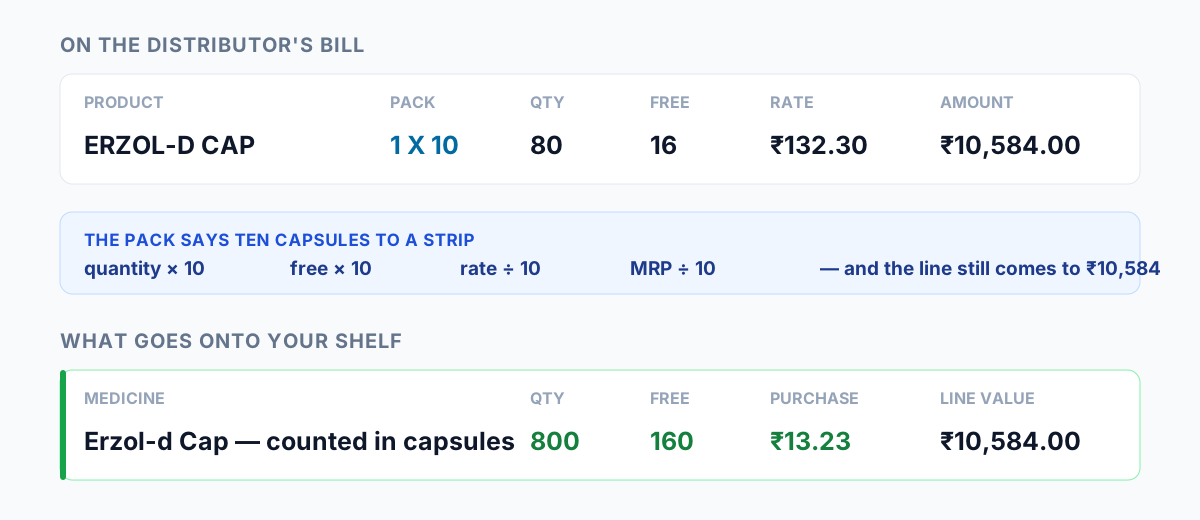
Here is a real line, of the kind that comes in every day:
One line, two correct answers
Look at the arithmetic before anything else. Eighty times 132.30 is 10,584 - exactly the amount printed at the end of the row. That one multiplication tells you what the bill means: the eighty is strips, and 132.30 is the price of a strip. Nothing on that line is per capsule.
Now look at the pack column: 1 X 10. Ten capsules to a strip. So the same line, counted the way the shop sells, is eight hundred capsules at ₹13.23 each - and 800 × 13.23 is still 10,584.
Both statements describe the same delivery and the same money. The danger is not in choosing one. It is in taking the quantity from one and the rate from the other.
What goes wrong when only one number moves
Suppose the quantity goes in as 80 - strips - but the medicine in your software is set up per capsule, priced at ₹13.23. The bill said 132.30, so that is what gets typed. Four things break at once, and none of them announce themselves:
- The shelf count is a tenth of reality. Eight hundred capsules arrived; the system believes eighty. Reorder alerts fire on a medicine you have eight boxes of.
- The purchase value is ten times the truth. At ₹132.30 a capsule, your stock-on-hand report is carrying a figure that was never spent.
- Every margin on that medicine is nonsense. Selling at ₹17.36 against a recorded cost of ₹132.30 reads as a loss on every sale.
- The expiry write-off, when it comes, is valued wrong too - in whichever direction hurts more.
The reverse mistake is quieter and worse: quantity entered as 800 at the strip rate of 132.30. The stock is right, the money is out by ₹95,000 on one line, and the purchase register will not tie to the bill.
Decide the unit once, and let it decide everything else
There is no universally correct answer to "strips or tablets". There is only a consistent one. The question to settle, per medicine, is simple:
What do you hand across the counter when somebody asks for the smallest amount you will sell?
For most tablets and capsules in an Indian medical store, that is a single tablet, or a few cut from a strip. Then the tablet is your unit: your stock is counted in tablets, your MRP is the per-tablet MRP, and your purchase rate is per tablet. For an ointment, a bottle of syrup or an inhaler, the thing you hand over is the whole pack - so the pack is the unit, and nothing needs dividing at all.
Write that decision down where the software can see it. The packing field on a medicine - "10 capsules", "15 tablets", "1 bottle" - is not decoration. It is the number that lets every later bill be read correctly, by you or by anybody you hire.
The arithmetic, and the rule that keeps it honest
Converting a line takes four operations and one check:
- quantity × pack size
- free quantity × pack size
- rate ÷ pack size
- MRP ÷ pack size
And the check, which matters more than any of them: the line value must not change. 80 × 132.30 and 800 × 13.23 both come to ₹10,584. If your converted line no longer agrees with the amount printed on the bill, something was misread - and the one thing never to do with a misread number is multiply it.
That check is also how you catch a bad pack column. A smudged "1X10" read as "1X100" would give you eight thousand capsules at ₹1.32, and the line would come to ₹10,584 either way - which is why the pack is worth a second's attention on a medicine you have not bought before.
Liquids and injections, where this goes badly wrong
The pack column does not always mean a count. A syrup line reads 200ML, and 200ML is one bottle - not two hundred of anything. Divide that rate by two hundred and a ₹151 bottle becomes seventy-five paise, which will look plausible for exactly as long as it takes somebody to sell one.
The rule to carry in your head: a number followed by a unit of volume or weight describes what is inside one container, so the container counts as one. A number on its own, or multiplied by another, is a count:
- 1X10, 10'S, 15 TAB - ten, ten and fifteen units.
- 10X10 - a box of ten strips of ten: a hundred units.
- 200ML, 450GM, 1 KIT - one unit.
- 10X5ML - ten ampoules of 5ml: ten units, not fifty.
Free goods are counted in the same unit
If sixteen free strips came with that delivery, a hundred and sixty capsules arrived free. Entering 16 against a medicine counted in capsules understates the stock by 144 - and understated stock is the kind that gets reordered, or gets written off as missing at the next count.
Whatever you do to the billed quantity, do to the free quantity. It is the same box of medicine.
Fixing a medicine that is already recorded the wrong way
If you find one - and the fastest way to find them is to compare a medicine's purchase price against its MRP, looking for a ratio of ten or fifteen - do not simply correct the price and move on. The price and the batch quantities have to be fixed together, or you swap one wrong number for another:
- Set the medicine's packing and unit to what you actually sell, first.
- Correct the purchase rate and MRP to that unit.
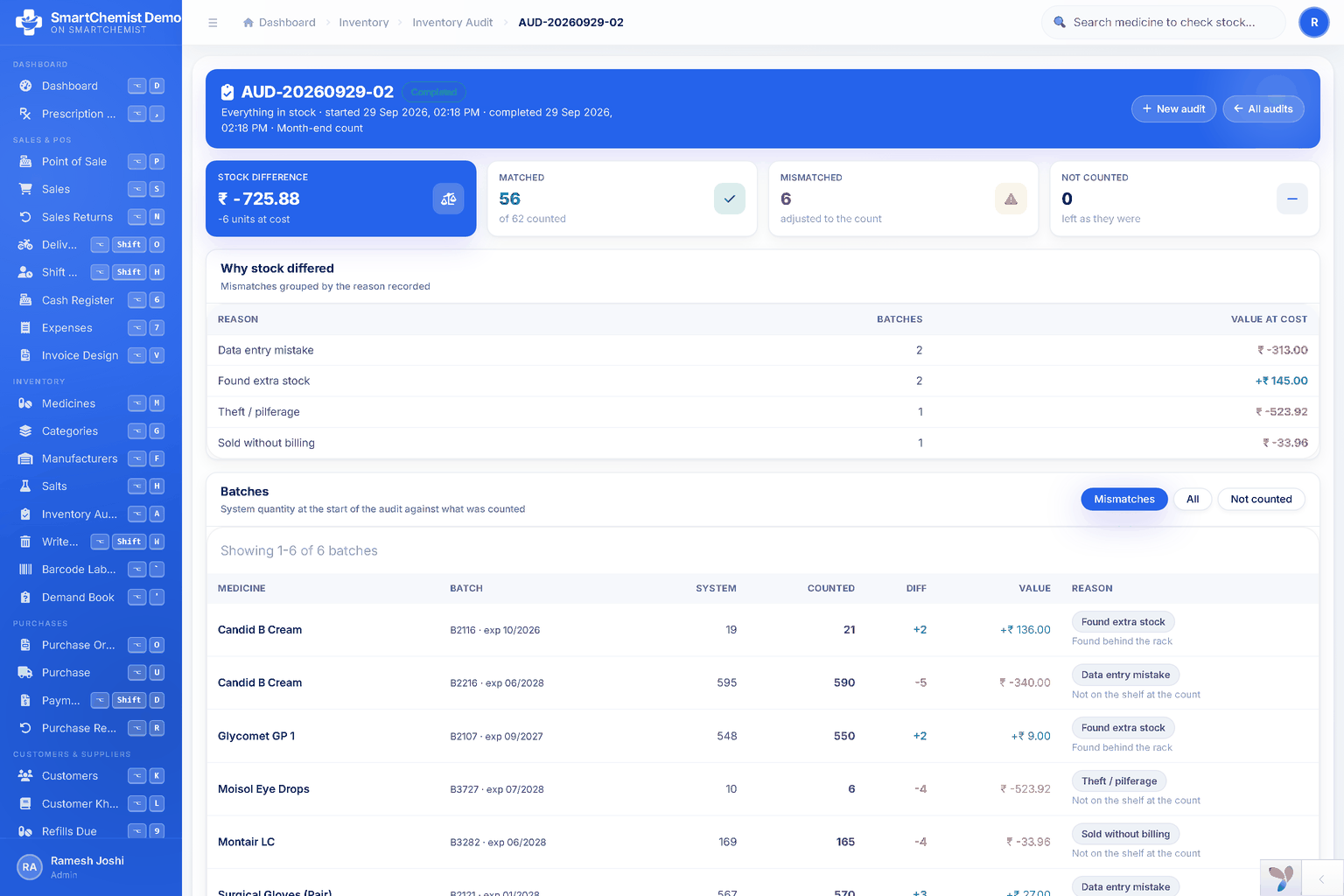
- Then adjust the stock on the open batches, through a stock adjustment, so the count matches what is physically on the shelf. The adjustment leaves a record of why it changed - which is exactly what you want when an audit asks.
- Leave closed and expired batches alone. They are history, and rewriting history to tidy a report is how a stock register stops being evidence.
While the bill is in your hand: the tax columns
One more thing that routinely goes in as zero. Most distributor bills print the tax in halves - CGST 2.50 and SGST 2.50 in two separate columns - because that is how it is charged within a state. Your purchase record wants the single rate: 5%. Two halves of six are 12, two of nine are 18.
A purchase entered at 0% GST is not a rounding error. It understates the input credit you are entitled to, and it quietly makes your GST purchase register disagree with the bills in the file.
Three things to check this week
- Pick a medicine you buy in strips and sell loose. Divide its MRP in your system by the MRP printed on the strip. If the answer is not 1, that medicine is recorded in one unit and billed in another.
- Open the last purchase bill you entered by hand and recalculate one line: quantity × rate. If it does not equal the amount on the bill, the line went in wrong, whatever the total said.
- Look at the GST column on your last five purchase entries. Any zeros that should not be there are input credit sitting unclaimed.
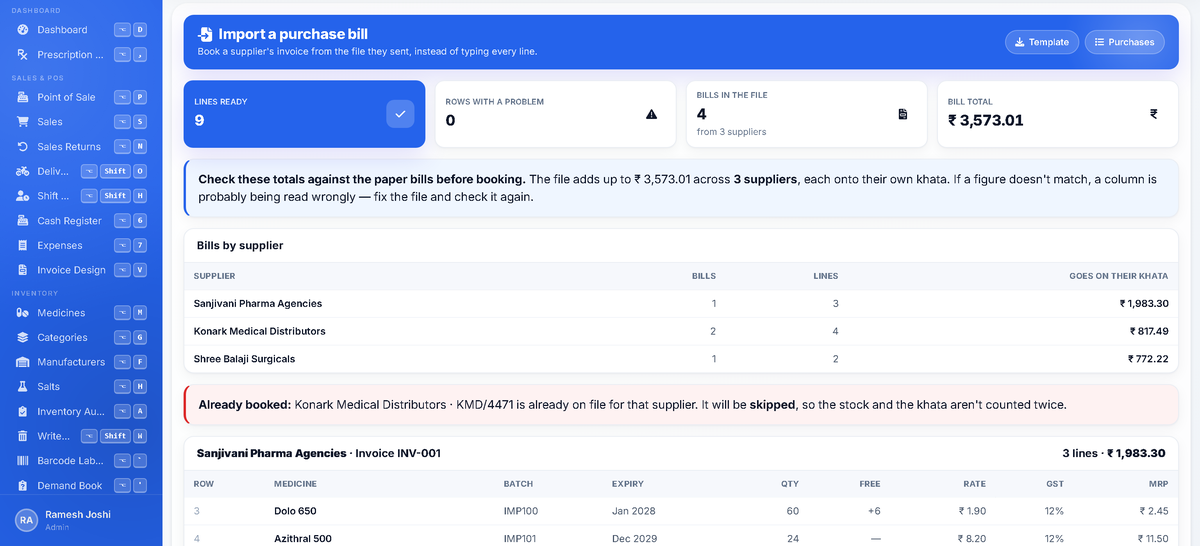
None of this is difficult arithmetic. It is just arithmetic nobody has time for at eight in the evening with four more bills to go - which is why it is worth having the software do it. In SmartChemist, scanning a distributor's bill reads the pack column along with everything else: strip lines are converted to the unit you sell in, with the quantity and the rate moved together, liquids are left alone, free goods are converted too, and the tax halves are added into one rate. Every figure the bill printed is kept beside what was entered, so you can see what changed before anything is saved.