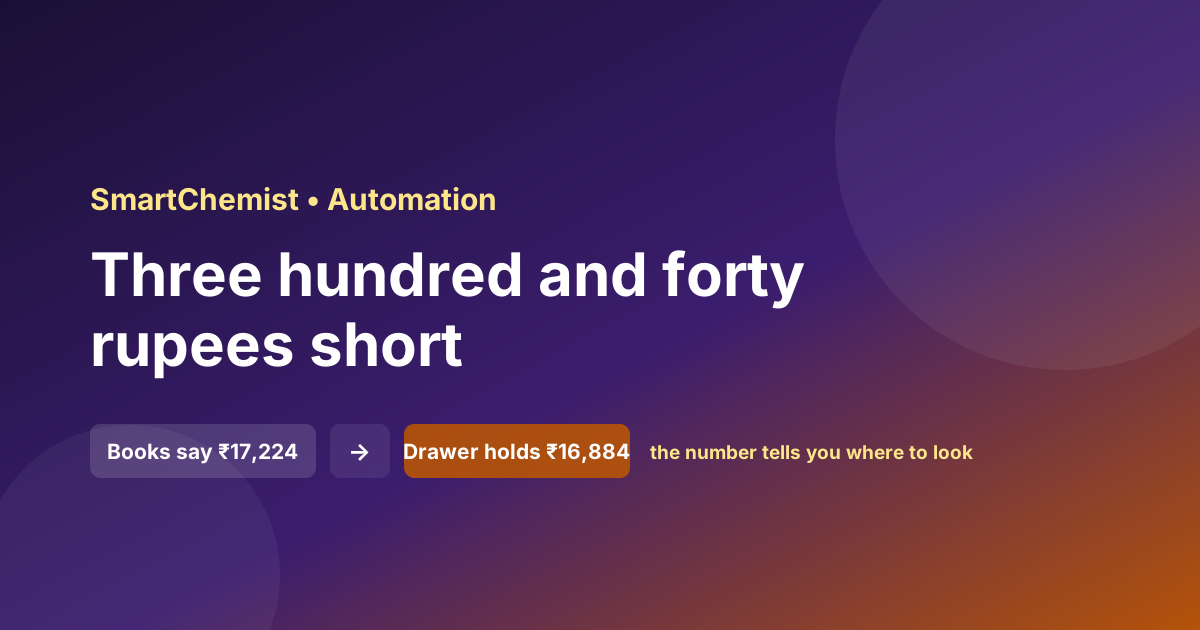
It is ten past nine. The shutter is half down, the counting is done twice, and the drawer is three hundred and forty rupees short.
What happens next is the same in most shops. Everybody looks at whoever was on the counter, nobody says the word out loud, the owner waves it away because three hundred and forty rupees is not worth an argument, and the same thing happens again on Thursday.
The instinct to look at a person is the wrong instinct, and not for sentimental reasons. It is wrong because the number in front of you is evidence, and almost nobody reads it.
What should be in the drawer is a six-line sum
Most shops check the till against one figure: the day's cash sales. That is why most shops cannot explain a shortage — cash sales is one of six things that moved money in and out of that drawer today.
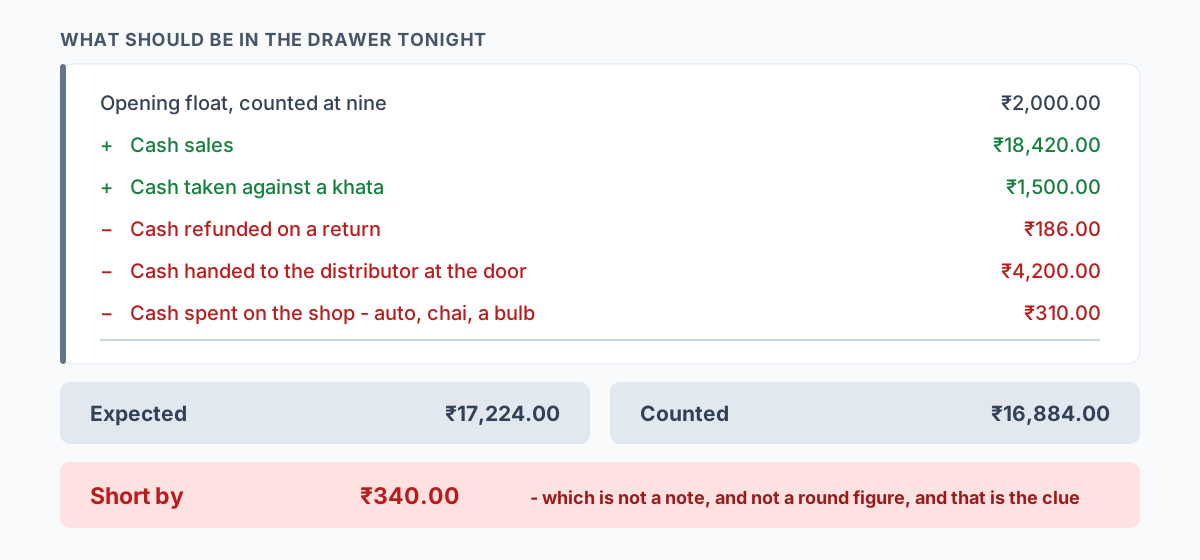
Six lines, and five of them are the ones people forget:
- The opening float. The money that was already there at nine. If it is a different amount every morning, every evening's count is guesswork.
- Khata collections. A regular walks in and settles two thousand rupees of old credit. No bill is raised, and two thousand rupees arrives in the drawer. Against a cash-sales figure, that reads as a two thousand rupee surplus.
- Refunds. Money that went out of the drawer with no record unless the return was entered properly.
- Cash to the distributor. The delivery man wants paying at the door, and four thousand rupees leaves the till without a single customer noticing.
- Shop expenses. An auto, tea for four, a tube light. Individually trivial, which is exactly why nobody writes them down, and collectively the single most common cause of a till that will not balance.
Until all six are recorded, the drawer cannot be checked against anything. It can only be compared with a feeling.
The shape of the difference tells you where to look
Here is the part worth keeping. A shortage is not a random number. Cash goes missing in a small number of ordinary ways, and each one leaves a differently shaped hole.
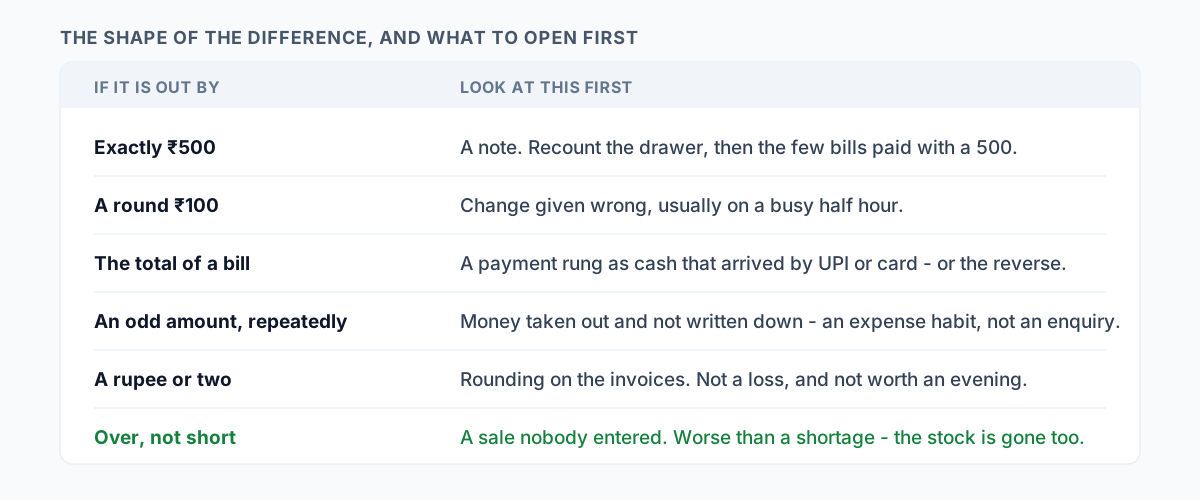
Our three hundred and forty is not a note and not a round figure, so the first place to look is the bills. And there it is: a customer paid ₹340 on his phone, and whoever was billing clicked cash. No money was stolen and nobody was careless with change. Three hundred and forty rupees is sitting in the bank account, counted twice — once by the bank, and once by a drawer that was told to expect it.
That mistake is worth understanding properly, because it is the commonest of the lot and it does not feel like a mistake at all. The bill was right. The total was right. The customer paid. Only the mode was wrong, and the mode is the one field nobody double-checks.
Split payments are where most shops lose the thread
It gets harder when one bill is paid two ways, which in 2026 is most of them. A bill of ₹1,247: five hundred in cash because that is what was in his pocket, the remaining ₹747 by UPI.
If your software records one payment mode per bill, you now have to choose which lie to tell it. Call it cash, and the drawer is expected to hold ₹747 that never arrived. Call it UPI, and the drawer holds ₹500 nobody can account for. Either way the till is wrong, the bank settlement is wrong, and both are wrong by an amount that looks like carelessness.
Multiply by twenty such bills a day and the evening count stops meaning anything at all — which is how shops end up not bothering to count.
A bill paid in parts has to be recorded in parts. The cash leg into the drawer count, the UPI and card legs into the bank settlement, the remainder onto the khata. Then each place is checkable against something real, and a difference in any one of them is information instead of noise.
Know whose shift it was, before you need to know
Suppose the shortage is real and keeps happening. If one drawer runs from nine in the morning to nine at night and three people stood at it, there is nothing to investigate. You have a number and no way to attach it to anything.
A shift handover costs about ninety seconds. The counter opens with a counted float; when the next person takes over, the till is counted and the figure written down; that count becomes the second person's opening float. The day close is unchanged — this just divides it into stretches that one person can answer for.
What makes it worth doing is not catching anybody. It is that a recurring shortage usually turns out to belong to a time rather than a person — the hour the school lets out, when three people are waiting and change gets given fast. Handovers show you that. One long shift hides it and leaves you suspecting the wrong thing.
Count the notes, not the total
One more small habit with a large payoff: count by denomination and record it that way — so many five hundreds, so many two hundreds, so many hundreds, down to the coins.
Two reasons. The first is that a denomination count catches its own mistakes: if the notes add up to a figure that differs from what you first counted, you recount before you go home rather than discovering it tomorrow. The second is that it makes a shortage legible. "Short ₹500" next to a count showing eleven five-hundred notes where yesterday showed twelve is a different problem from "short ₹500" made up of small change — the first is a note, the second is thirty transactions of sloppy change.
It also tells you what to take to the bank and what to leave as tomorrow's float, which is the other question being asked at closing time.
What a shortage is actually costing you
Three hundred and forty rupees, three times a week, is roughly ₹53,000 a year. On a pharmacy netting seven per cent, you have to sell about ₹7.5 lakh of medicine to earn it back.
That is the real argument for spending ten minutes on the till. Not suspicion — arithmetic. And in the great majority of shops that start counting properly, the money turns out not to have been stolen at all. It was an expense nobody wrote down, a khata payment that went in as a sale, and a UPI bill rung as cash.
Three things to do this week
- Fix the float. Decide the amount that stays in the drawer overnight — two thousand, five hundred, whatever suits your change — and start every day from exactly that. One decision, and tonight's count becomes checkable.
- Write down every rupee that leaves the till for something that is not a refund. For one week, on paper if need be. Most owners are startled by the total, and it is almost always the whole of the mystery.
- Take yesterday's shortfall and ask what shape it is. If it matches a bill total, go and find that bill and look at how it was paid. You will likely have your answer in two minutes, and it will not be about a person.
A till that balances is not about trust. It is about being able to tell the difference between a problem and a typing error — which is a kindness to whoever is standing at your counter, as much as it is to you.
In SmartChemist the drawer is worked out from all six lines rather than from sales alone: the float you set, cash sales, cash taken against a khata, refunds, cash paid to suppliers and shop expenses by category. A bill can be paid part cash and part UPI and each part goes where it belongs. The day closes on a denomination count with the variance named rather than absorbed, shifts hand over with a count in between, and the Day Book sits behind all of it when you want to know what a Thursday actually looked like.