
Most compliance conversations in a medical store are about GST. But the record that actually gets asked for during a drug inspection is usually a different one: the Schedule H1 register. It is a small book, it takes seconds per sale, and it is the single most common thing a chemist gets pulled up for.
Here is what it covers, what has to go in it, and how to keep it without turning every counter sale into paperwork.
What Schedule H1 Actually Is
Schedule H1 was added to the Drugs and Cosmetics Rules and came into force on 1 March 2014. It was a response to a specific problem: antibiotics and anti-TB drugs being bought over the counter, course after course, without a prescription and without anyone tracking it. The result was resistance building up in the population faster than new drugs could be developed.
So a defined list of medicines was pulled out of the wider Schedule H and given stricter handling. The list covers three broad groups:
- Third and fourth generation antibiotics — the ones that matter most when resistance develops
- Anti-TB drugs, where an incomplete course is worse than no course at all
- Certain habit-forming drugs, including some sedatives and anti-anxiety medicines
Two things follow from a drug being on that list. The pack carries a label with a red box on the left and the Rx symbol, along with a warning that it must not be sold without a prescription. And every single sale of it has to be written into a separate register.
What Goes in the Register
The register is not the same as your bill book, and a bill is not a substitute for it. For each sale of a Schedule H1 drug, you record:
- The date of supply
- The name and address of the prescriber — the doctor, not the patient
- The name of the patient
- The name of the drug dispensed
- The quantity supplied
The register has to be kept for three years and produced for inspection on demand. That last part is where most stores come unstuck — not because they refused, but because the book from eighteen months ago is somewhere under the counter with pages missing.
Four Mistakes That Cost Stores
1. Treating the prescription as the record
Keeping the prescription copy is good practice, but it is not the register. The register is a running log, in order, that an inspector can read start to finish. A folder of loose prescriptions is not that.
2. Writing it up at the end of the day
By closing time nobody remembers which of the day's forty bills included a Schedule H1 item, or which doctor wrote it. Entries get skipped, and skipped entries are exactly what an inspection finds. The entry has to happen at the counter, with the prescription in hand.
3. Not knowing which of your own medicines are on the list
This is the quiet one. A store might stock two hundred formulations and have no marked-up list of which ones are H1. So the register gets filled for the obvious antibiotics and missed entirely for a sedative nobody thought about. Go through your stock once, item by item, and mark them. It is a morning's work and it is the difference between a register that is complete and one that only looks complete.
4. Letting the register and the stock disagree
If your register shows ten strips dispensed this month but your stock movement shows twenty-five sold, that gap is a question you will have to answer. The two records should be reconcilable, and if they are not, it is usually the register that is incomplete rather than the stock that is wrong.
Making It Take Seconds Instead of Minutes
The compliance burden here is not really the writing. It is the remembering — that this particular medicine, on this particular bill, needs three extra fields captured before the customer walks out.
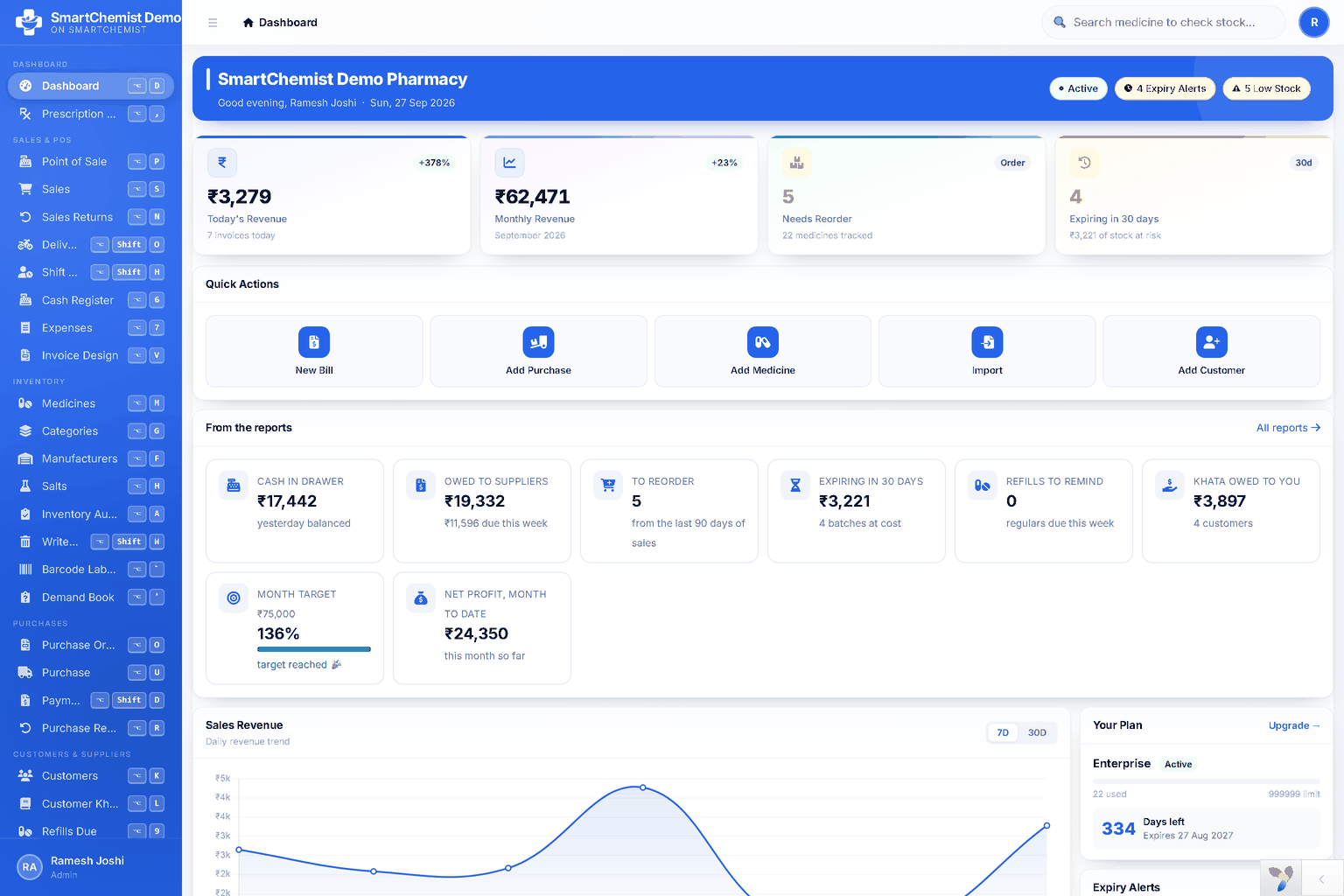
That is a job software is well suited to. In SmartChemist, marking a medicine as Schedule H1 means the billing screen prompts for the prescriber and patient details when that item is added to a bill, rather than relying on the person at the counter to remember. Because the entries are stored against the sale, the register can be printed for any date range, and it reconciles with stock movement by construction — the two come from the same records.
Whether you do it on paper or on screen, the principle is the same:
- Capture at the counter, never at closing time
- Keep the list of which of your medicines are H1 written down and current
- Store three years, and be able to find any month of it in under a minute
- Check the register against stock movement once a month, not once a year
Why This Is Worth the Effort
It is tempting to treat this as one more form to fill. But the reason Schedule H1 exists is genuinely serious: antibiotic resistance is a public health problem that pharmacies sit right in the middle of. A chemist who insists on a prescription and records the sale is doing something that matters, not just something that is required.
The compliance side is simply the version of that you can be inspected on. Get the habit right at the counter and the inspection takes care of itself.
A Quick Self-Check
Before your next inspection, answer these four honestly:
- Can you produce the H1 register for a randomly chosen week from last year in under a minute?
- Does every entry have a prescriber name and address?
- Do you have a written list of which medicines in your current stock are H1?
- If you compared last month's register against last month's stock movement, would they agree?
If any answer is no, that is where to start. None of the four takes more than a morning to fix, and all four are things an inspector will look at.