Loading SmartChemist...
Analytics

Understanding Sales Analytics in Pharmacy: A Complete Guide for Smarter Business Growth

Understanding Sales Analytics in Pharmacy

In today's competitive healthcare industry, running a pharmacy is no longer limited to dispensing medicines. Modern pharmacies generate thousands of transactions every month, creating valuable business data that can help owners make smarter decisions. The challenge isn't collecting data—it's understanding it.

This is where Sales Analytics plays a crucial role.

Whether you operate a single medical store or manage multiple pharmacy branches, sales analytics helps you understand customer buying patterns, monitor business performance, optimize inventory, and maintain GST compliance.

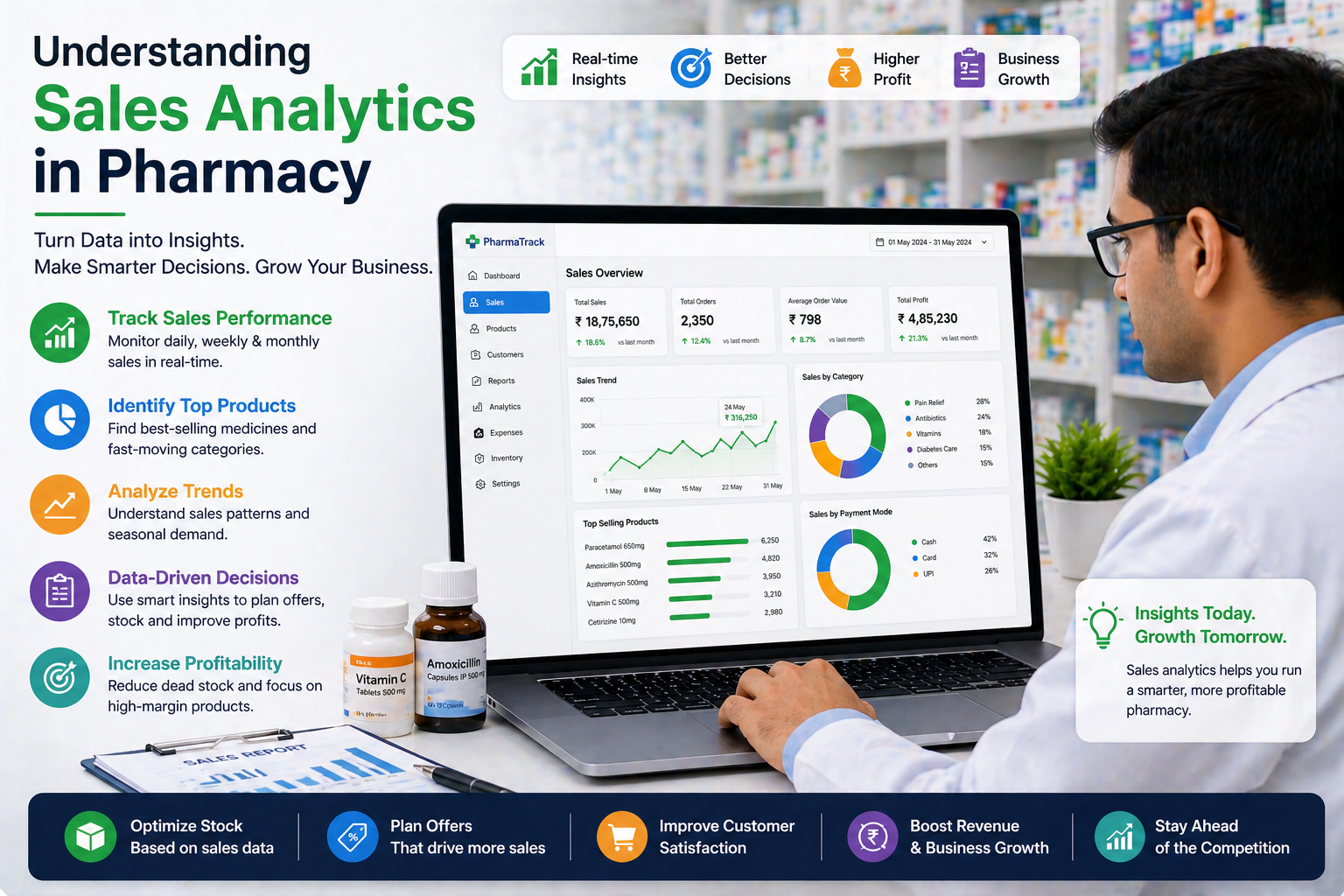
With cloud-based Pharmacy Management Software, sales analytics has become more accessible than ever. Instead of relying on manual reports or spreadsheets, pharmacy owners can view real-time dashboards that reveal exactly how their business is performing.

In this article, we'll explore everything you need to know about Sales Analytics in Pharmacy, why it matters, key reports to track, GST implications, and how analytics can help increase profitability.

What is Sales Analytics?

Sales Analytics is the process of collecting, organizing, analyzing, and interpreting sales data to improve business performance.

For pharmacies, this includes analyzing:

  • Daily sales
  • Monthly revenue
  • Medicine-wise sales
  • Category performance
  • Prescription vs OTC sales
  • Profit margins
  • Customer purchasing behavior
  • GST reports
  • Inventory movement

Instead of making assumptions, pharmacy owners can make decisions based on accurate business data.

Why Sales Analytics is Important for Pharmacies

The pharmaceutical retail industry operates with:

  • Thin profit margins
  • Expiry-sensitive inventory
  • Strict GST regulations
  • Seasonal medicine demand
  • Prescription-based sales

Without proper analytics, pharmacies may experience:

  • Overstocking
  • Stock shortages
  • Expired medicines
  • Reduced profits
  • GST filing errors
  • Poor purchasing decisions

Sales analytics provides complete visibility into business operations.

Benefits include:

  • Better inventory planning
  • Increased profitability
  • Faster business decisions
  • Improved customer service
  • Accurate GST reporting
  • Better supplier negotiations

Key Pharmacy Sales Metrics to Track

Monitoring the right metrics helps pharmacy owners identify strengths and weaknesses.

1. Daily Sales

Track:

  • Total sales amount
  • Number of bills generated
  • Average bill value
  • Peak business hours

This helps understand daily business performance.

2. Monthly Revenue

Monthly reports help identify:

  • Business growth
  • Seasonal trends
  • Revenue fluctuations
  • Target achievement

Comparing monthly performance helps improve planning.

3. Medicine-wise Sales Analysis

Know exactly which medicines generate maximum revenue.

Example:

MedicineUnits SoldRevenue
Paracetamol850₹42,500
Vitamin D3420₹31,800
Insulin210₹84,000

This helps optimize purchasing decisions.

4. Category-wise Sales

Analyze categories such as:

  • Antibiotics
  • Diabetes medicines
  • Cardiac medicines
  • Baby care
  • Personal care
  • Surgical products
  • Wellness products

Category analytics reveals which product segments contribute the highest revenue.

5. Customer Purchase Analysis

Sales analytics can answer questions like:

  • Who are your repeat customers?
  • Which customers spend the most?
  • Which medicines are frequently purchased together?
  • How often do customers revisit?

This information helps build customer loyalty programs.

Role of GST in Pharmacy Sales Analytics

Every pharmacy in India must maintain accurate GST records.

Sales analytics integrated with GST helps automate tax reporting and reduce compliance risks.

Benefits include:

  • Automatic GST calculation
  • HSN code management
  • Tax-wise sales reports
  • CGST, SGST, and IGST summaries
  • GST return preparation
  • Invoice validation
  • Audit-ready reports

This significantly reduces manual accounting work.

GST Reports Every Pharmacy Should Monitor

Important GST-related reports include:

  • GST Sales Register
  • GST Purchase Register
  • Tax Summary
  • HSN Summary
  • GSTR Reports
  • Tax Liability Report
  • Input Tax Credit Report

These reports simplify monthly and annual GST filing.

Inventory Analytics and Sales

Sales analytics isn't only about revenue.

It also improves inventory management.

Analytics identifies:

  • Fast-moving medicines
  • Slow-moving inventory
  • Dead stock
  • Near-expiry products
  • Overstocked medicines
  • Frequently out-of-stock items

This reduces inventory losses and improves cash flow.

Identifying Fast-Moving Medicines

Fast-moving medicines should always remain in stock.

Examples:

  • Painkillers
  • Fever medicines
  • Diabetes medicines
  • Blood pressure medicines
  • Vitamins

Sales analytics automatically identifies these products.

Benefits include:

  • Reduced stock-outs
  • Higher customer satisfaction
  • Better supplier planning

Detecting Slow-Moving Stock

Slow-moving inventory blocks working capital.

Sales analytics helps identify products that:

  • Sell rarely
  • Occupy shelf space
  • Have declining demand

Owners can then:

  • Offer discounts
  • Bundle products
  • Reduce future purchases

Expiry Management Through Analytics

Medicine expiry is one of the biggest losses in pharmacy businesses.

Analytics can identify:

  • Products nearing expiry
  • Shelf-life remaining
  • Unsold batches
  • Vendor return opportunities

This minimizes wastage and protects profits.

Profit Margin Analysis

Revenue doesn't always mean profit.

Sales analytics calculates:

  • Gross profit
  • Net profit
  • Margin by medicine
  • Margin by supplier
  • Margin by category

Example:

Medicine A

  • Selling Price: ₹120
  • Purchase Price: ₹90
  • Profit: ₹30

Medicine B

  • Selling Price: ₹600
  • Purchase Price: ₹590
  • Profit: ₹10

Although Medicine B generates higher revenue, Medicine A provides a better margin.

Supplier Performance Analysis

Pharmacy analytics also evaluates supplier performance.

Track:

  • Purchase frequency
  • Delivery delays
  • Product availability
  • Purchase cost
  • Return percentage

This helps negotiate better pricing and improve procurement.

Customer Analytics

Customer insights are extremely valuable.

Analytics helps identify:

  • Regular customers
  • High-value customers
  • Seasonal buyers
  • Prescription customers
  • Loyalty program members

This enables targeted marketing campaigns.

Prescription vs OTC Sales

Understanding the balance between prescription medicines and over-the-counter (OTC) products helps pharmacies diversify revenue.

Analytics can compare:

  • Prescription sales
  • OTC sales
  • Wellness products
  • FMCG healthcare products

Many pharmacies discover that wellness products offer higher profit margins than prescription medicines.

Seasonal Sales Trends

Medicine demand changes throughout the year.

Examples include:

Summer:

  • ORS
  • Sunscreen
  • Electrolytes

Monsoon:

  • Antibiotics
  • Antifungal medicines
  • Mosquito repellents

Winter:

  • Cough syrups
  • Vitamin supplements
  • Cold medicines

Sales analytics helps pharmacies prepare inventory in advance.

Multi-Branch Sales Analytics

For pharmacy chains, centralized analytics offers significant advantages.

Owners can compare:

  • Branch-wise revenue
  • Branch-wise profit
  • Inventory availability
  • Top-performing branches
  • Employee productivity

This enables consistent performance across locations.

Employee Performance Reports

Sales analytics also measures staff efficiency.

Reports may include:

  • Bills generated
  • Sales value
  • Average billing time
  • Customer handling
  • Return transactions

These insights support training, incentives, and workforce planning.

Real-Time Dashboards

Modern pharmacy software provides live dashboards displaying:

  • Today's sales
  • Cash collection
  • UPI payments
  • Card payments
  • Pending credit
  • Stock alerts
  • GST summary
  • Top-selling medicines

Business owners can monitor performance anytime from desktop or mobile devices.

How Pharmacy Management Software Simplifies Sales Analytics

Manual calculations consume time and often lead to errors.

Modern Pharmacy Management Software automates:

  • Sales reporting
  • Inventory tracking
  • GST calculations
  • Profit analysis
  • Customer reports
  • Purchase analytics
  • Financial summaries
  • Business dashboards

Automation enables pharmacy owners to focus more on customer service and business growth.

Best Practices for Using Sales Analytics

To maximize the value of analytics:

  • Review sales reports daily.
  • Analyze monthly revenue trends.
  • Monitor fast- and slow-moving inventory.
  • Check profit margins regularly.
  • Reconcile GST reports before filing.
  • Track customer purchasing behavior.
  • Review supplier performance quarterly.
  • Use dashboards to make data-driven decisions.

Consistent monitoring leads to better business outcomes.

Common Mistakes Pharmacies Should Avoid

Many pharmacies fail to benefit from analytics because they:

  • Ignore business reports.
  • Maintain manual records.
  • Delay inventory analysis.
  • Skip GST reconciliation.
  • Overstock slow-moving medicines.
  • Overlook customer buying patterns.
  • Make purchasing decisions based on assumptions.

Avoiding these mistakes can significantly improve profitability and operational efficiency.

Future of Sales Analytics in Pharmacy

The future of pharmacy analytics is driven by Artificial Intelligence (AI) and predictive insights.

Emerging capabilities include:

  • Demand forecasting
  • Automated stock replenishment
  • Intelligent pricing recommendations
  • Customer purchase predictions
  • Smart expiry management
  • Personalized promotions
  • Voice-enabled reporting
  • Mobile analytics dashboards

These technologies will help pharmacies become more efficient, profitable, and customer-centric.

Sales Analytics Pharmacy GST
Share:
ST
SmartChemist Team

Writes about pharmacy operations, inventory management and billing for SmartChemist — helping medical stores across India run smarter, more profitable businesses.